A 30% Black Friday discount means selling 4x as much. Is that the plan?
Before you set a Black Friday discount, work out how many more orders it needs just to break even, and which offers cost you less.
 Achour Khattallah
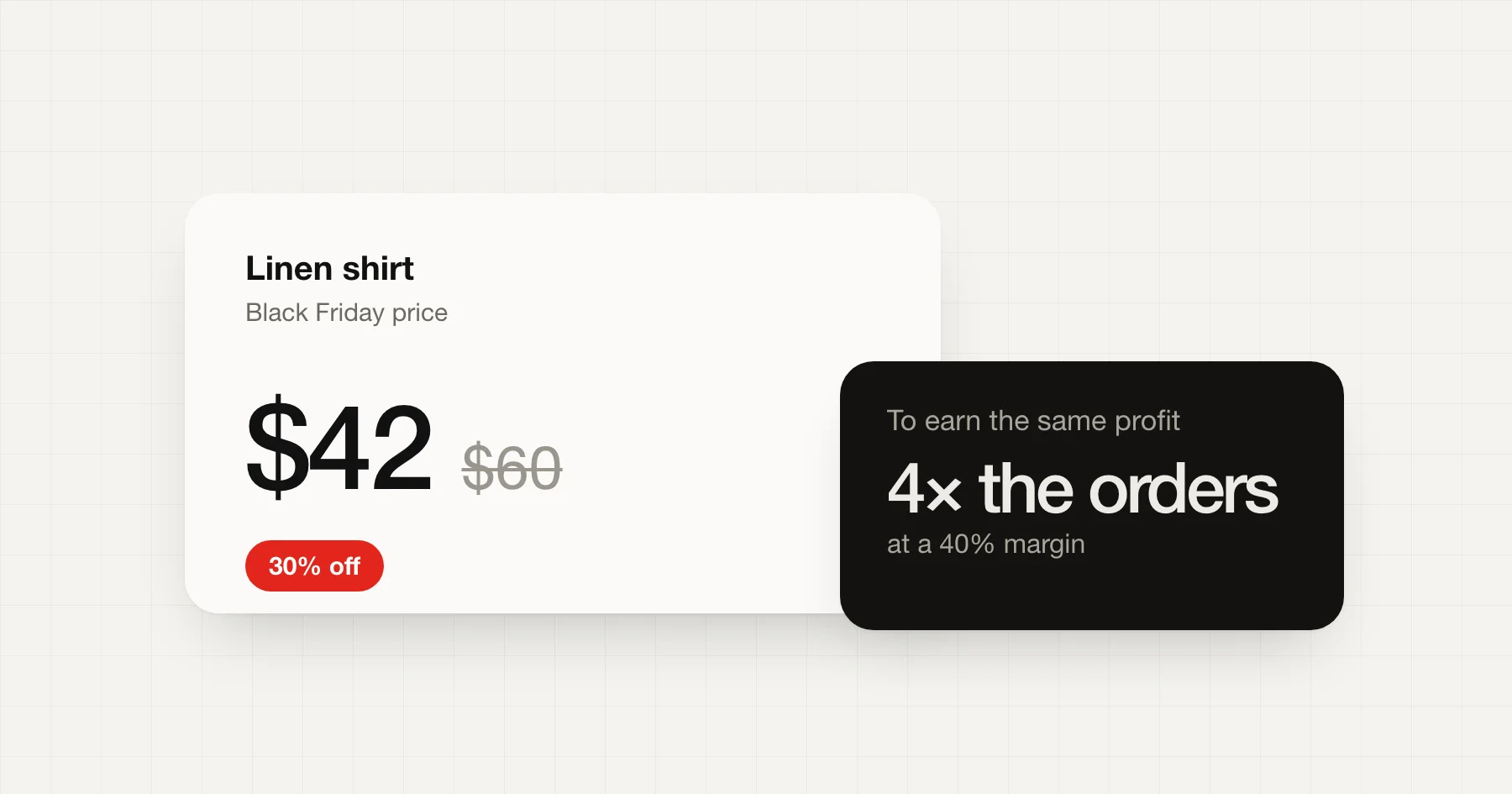
Most stores pick their Black Friday discount by looking at what everyone else is doing. 20% feels timid, 30% feels like a real sale, so 30% it is. But a discount doesn't come off your price. It comes off your profit, and that's a much smaller number.
For a store with a 40% margin, 30% off means you need four times as many orders just to make the same money as a normal day. Not more money. The same money. So before you pick a number, it's worth knowing what that number asks of you.
The one number to work out first
Every discount has a break-even point: how many more orders it needs before it pays for itself. It only takes two numbers to find it, your gross margin and the discount.
orders needed = margin ÷ (margin − discount)
That gives you a multiple of your usual orders. A result of 2 means twice as many orders to earn the same profit. If the discount is as big as your margin, there's no answer at all, because every order now makes nothing or loses money.
Use your real margin here, the one left after product cost, the shipping you pay, payment fees and returns. If you worked it out for the CPC post, use that same number.
What it means for the shirt shop
Back to the linen shirt shop. It sells a $60 shirt, and after everything it pays, it keeps 40% of each sale:
- Price of a shirt
- $60
- Gross margin
- 40%
- Profit on each order
- $24
Now take 30% off. The shirt sells for $42, but the shop still pays the same $36 to make, ship and sell it. The $18 discount comes entirely out of the $24 it used to keep.
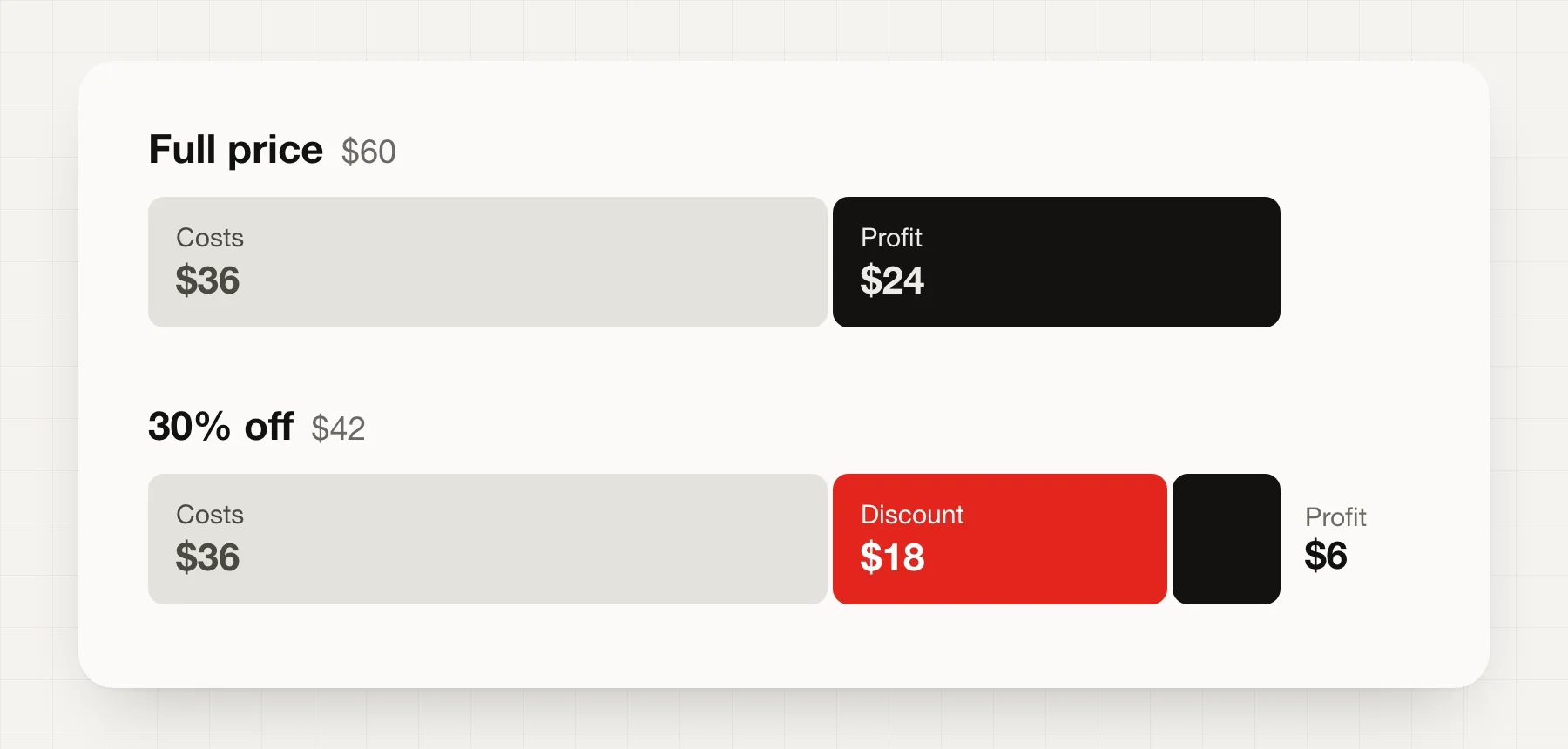
So the shop goes from $24 profit per order to $6. To end the day with the same money, it needs four orders for every one it would normally get:
- No discount1.0×
- 10% off1.3×
- 20% off2.0×
- 30% off4.0×
Each step of 10% costs more than the one before, because it comes out of a shrinking profit.
Look at how the bars grow. Going from 10% to 20% off adds less than one extra order per usual order. Going from 20% to 30% adds two. The last 10% is by far the most expensive.
It hits ads too. A click is worth less when each order earns less, so the most the shop can afford to pay per click drops with the margin. At 30% off, a click that was worth sixty cents is worth closer to fifteen, unless the sale lifts the conversion rate enough to make up for it.
Try it with your numbers
The calculator starts with the shirt shop. Change the price, your margin and the discount you're thinking about:
Discount break-even calculator
Move the sliders to match your store.
- Profit per order now
- $24
- With the discount
- $6
- Orders needed
- 40
- Times your usual
- 4.0×
To make the same profit as 10 full-price orders, you need 40 orders at 30% off. That's 30 extra orders just to stand still.
Try sliding the discount up to your margin. The order count stops making sense, and that's the point: past that line, every sale costs you money.
Offers that cost less than a discount
A discount is only one way to give shoppers a reason to buy now. Some of the others cost you far less per order. Here they are for the shirt shop, which keeps $24 on a normal order:
| Offer | Costs you per order | Profit per order | Orders needed |
|---|---|---|---|
| 30% off | $18 | $6 | 4× |
| 20% off | $12 | $12 | 2× |
| 10% off | $6 | $18 | 1.3× |
| Free linen pouch with every shirt | $4 | $20 | 1.2× |
| $15 off when you buy two | $15 | $33 on two shirts | Depends |
| Early access at full price | $0 | $24 | 1× |
A few notes on the less obvious ones:
- A free gift works when it's worth more to the shopper than it costs you. A pouch, a care kit or a sample of something else you sell can feel like $15 of value and cost you $4. You also don't train anyone to expect your prices to drop.
- "Buy two, save $15" is the interesting one. If it turns a one-shirt order into a two-shirt order, the shop makes $33 instead of $24, so it's better off than with no offer at all. If the shopper was going to buy two anyway, the shop makes $33 instead of $48. It pays when your typical order is one item and many shoppers are on the fence about a second.
- Early access costs nothing but an email. Letting your list shop the new colour or the restock a day before everyone else gives them a reason to buy now without touching the price.
None of these will look as loud as a big red "30% OFF" banner. That's fine. The banner is there to get attention, but the profit is what pays your bills in January.
When a deep discount still makes sense
There are times when a big discount is the right call. Two come up most often.
Stock that won't sell at full price anyway. Last season's colours, the size run that never moved, the product you're discontinuing. The full margin on these is only on paper. The real question is what you'd get for them later, in a clearance sale or not at all. Against that, 40% off in November can be the best offer you'll get. Keep the deep discount on that stock, not the whole store.
First orders from people who come back. If a Black Friday buyer goes on to order again at full price, the first order can afford a thin margin. But that only holds if they really do come back. Look at last year's Black Friday customers and count how many ordered again. If it's only a handful, the discount bought you one sale, not a customer.
What doesn't count as a reason: "everyone else is doing 30%." Their margins and their stock aren't yours.
A check before you set the offer
If the orders needed look realistic, go ahead and run the sale with your eyes open. If they don't, a smaller discount or a smarter offer will probably leave you with more money on December 1, even if it sells fewer shirts.